Art 179e Hm01 Modern Contemporary Art Practices Special Topics in Art
Definition of Modern Art
Mod art is the creative globe's response to the rationalist practices and perspectives of the new lives and ideas provided by the technological advances of the industrial age that caused contemporary society to manifest itself in new ways compared to the past. Artists worked to represent their experience of the newness of modern life in appropriately innovative ways. Although modern fine art as a term applies to a vast number of creative genres spanning more than a century, aesthetically speaking, modern art is characterized past the artist'southward intent to portray a bailiwick as it exists in the world, according to his or her unique perspective and is typified by a rejection of accustomed or traditional styles and values.
The Beginnings of Modernistic Art
Classical and Early Modern Art

The centuries that preceded the modernistic era witnessed numerous advancements in the visual arts, from the humanist inquiries of the Renaissance and Baroque periods to the elaborate fantasies of the Rococo style and the platonic physical beauty of xviiithursday-century European Neoclassicism. Yet, 1 prevalent characteristic throughout these early on modern eras was an idealization of subject matter, whether human, natural, or situational. Artists typically painted not what they perceived with subjective eyes just rather what they envisioned as the epitome of their subject.
Historic period of Modernism and Art
The modernistic era arrived with the dawn of the industrial revolution in Western Europe in the mid-19th century, one of the most crucial turning points in earth history. With the invention and wide availability of such technologies as the internal combustion engine, large machine-powered factories, and electric power generation in urban areas, the pace and quality of everyday life changed drastically. Many people migrated from the rural farms to the city centers to find piece of work, shifting the center of life from the family and hamlet in the country to the expanding urban metropolises. With these developments, painters were drawn to these new visual landscapes, now bustling with all diversity of modern glasses and fashions.
A major technological development closely-related to the visual arts was photography. Photographic technology chop-chop advanced, and inside a few decades a photograph could reproduce whatever scene with perfect accuracy. As the engineering science developed, photography became increasingly accessible to the general public. The photograph conceptually posed a serious threat to classical creative modes of representing a subject, as neither sculpture nor painting could capture the aforementioned degree of detail as photography. Equally a result of photography's precision, artists were obliged to find new modes of expression, which led to new paradigms in art.
The Artist's Perspective and Modern Art
In the early decades of the 19th century, a number of European painters began to experiment with the simple deed of observation. Artists from across the continent, including portraitists and genre painters such as Gustave Courbet and Henri Fantin-Latour, created works that aimed to portray people and situations objectively, imperfections and all, rather than creating an idealized rendition of the subject field. This radical approach to art would come up to contain the wide school of art known as Realism.
Also early in the 19th century, the Romantics began to nowadays the landscape not necessarily every bit it considerately existed, but rather as they saw and felt information technology. The landscapes painted past Caspar David Friedrich and J.M.W. Turner are dramatic representations that capture the feeling of the sublime that struck the creative person upon viewing that particular scene in nature. This representation of a feeling in conjunction with a place was a crucial stride for creating the modernistic artist's innovative and unique perspective.
Early Abstraction and Mod Art

Similarly, while some artists focused on objective representation, others shifted their artistic focus to emphasize the visual sensation of their observed subjects rather than an accurate and naturalistic delineation of them. This exercise represents the beginnings of abstraction in the visual arts. Two primal examples of this are James McNeill Whistler'southward Nocturne in Blackness and Gilt: The Falling Rocket (1874) and Claude Monet'due south Boulevard des Capucines (1873). In the quondam, the artist couples large splatters and small flecks of paint to create a portrait of a nighttime sky illuminated by fireworks that was more atmospheric than representational. In the latter, Monet provides an aeriform view of bustling modern Parisian life. In portraying this scene, Monet rendered the pedestrians and cityscape equally an "impression," or in other words, a visual representation of a fleeting, subjective, and slightly bathetic, perspective.
Modern Art Themes and Concepts
Modern Artists

The history of modern art is the history of the tiptop artists and their achievements. Mod artists have strived to express their views of the world around them using visual mediums. While some have connected their work to preceding movements or ideas, the general goal of each artist in the mod era was to advance their practice to a position of pure originality. Certain artists established themselves as contained thinkers, venturing beyond what constituted acceptable forms of "high art" at the time which were endorsed by traditional state-run academies and the upper-class patrons of the visual arts. These innovators depicted discipline matter that many considered lewd, controversial, or even downright ugly.
The first modernistic artist to substantially stand on his own in this regard was Gustave Courbet, who in the mid-19thursday century sought to develop his own distinct style. This was achieved in large part with his painting from 1849-1850, Burying at Ornans, which scandalized the French art world by portraying the funeral of a common human being from a peasant village. The University bristled at the depiction of dirty farm workers around an open up grave, every bit simply classical myths or historical scenes were fitting subject field matter for such a large painting. Initially, Courbet was ostracized for his work, but he eventually proved to be highly influential to subsequent generations of mod artists. This general pattern of rejection and later influence has been repeated by hundreds of artists in the modern era.
Modern Art Movements
The discipline of art history tends to classify individuals into units of like-minded and historically continued artists designated equally the dissimilar movements and "schools." This simple arroyo of establishing categories is specially apt every bit it applies to centralized movements with a singular objective, such as Impressionism, Futurism, and Surrealism. For instance, when Claude Monet exhibited his painting Impression, Sunrise (1872) as part of a group exhibition in 1874, the painting and the exhibition as a whole were poorly received. Withal, Monet and his fellow artists were ultimately motivated and united by the criticism. The Impressionists thus set up a precedent for futurity independently minded artists who sought to group together based on a singular objective and aesthetic approach.
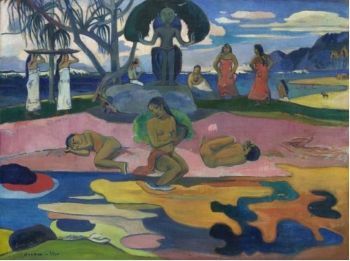
This exercise of group artists into movements is not e'er completely accurate or appropriate, as many movements or schools consist of widely diverse artists and modes of artistic representation. For example, Vincent van Gogh, Paul Gauguin, Georges Seurat and Paul Cézanne are considered the master artists of Mail-Impressionism, a movement named and then considering of the artists' deviations from Impressionist motifs every bit well as their chronological place in history. Dissimilar their predecessors, yet, the Mail-Impressionists did not represent a cohesive movement of artists who united under a single ideological banner. Furthermore, the case tin can be made that some artists practice not fit into any item motility or category. Key examples include the likes of Auguste Rodin, Amadeo Modigliani, and Marc Chagall. Despite these complications, the imperfect designation of movements allows the vast history of mod art to be broken down into smaller segments separated by contextual factors that aid in examining the individual artists and works.
The Avant-garde and The Progression of Modern Fine art
The avant-garde is a term that derives from the French "vanguard," the pb division going into battle, literally accelerate guard, and its designation within mod art is very much like its military namesake. Generally speaking, virtually of the successful and artistic modern artists were avante-gardes. Their objective in the modernistic era was to advance the practices and ideas of fine art, and to continually challenge what constituted acceptable artistic form in order to virtually accurately convey the creative person'south experience of modern life. Modern artists continually examined the past and revalued it in relation to the mod.
Modernistic, Gimmicky, and Postmodern Fine art
By and large speaking, gimmicky art is defined as any form of art in any medium that is produced in the nowadays mean solar day. However, within the fine art world the term designates art that was made during and after the post-Pop fine art era of the 1960s. The dawn of Conceptualism in the late 1960s marks the turning indicate when modern art gave mode to contemporary fine art. Contemporary art is a broad chronological delineation that encompasses a vast array of movements like Earth art, Functioning art, Neo-Expressionism, and Digital art. It is non a conspicuously designated period or way, simply instead marks the end of the periodization of modernism.
LHOOQ (1919) was an early example of an artist questioning the progress of art, and pointing to postmodern movements such as Conceptual art, Appropriation Art, and other practices." data-initial-src="/images20/photo/modern_art_6.jpg" width="193" height="315" src="https://www.theartstory.org/images20/photo/modern_art_6.jpg">
Postmodernism is the reaction to or a resistance against the projects of modernism, and began with the rupture in representation that occurred during the late 1960s. Modernism became the new tradition constitute in all the institutions against which it initially rebelled. Postmodern artists sought to exceed the limits set up past modernism, deconstructing modernism's k narrative in order to explore cultural codes, politics, and social ideology within their immediate context. It is this theoretical engagement with the ideologies of the surrounding world that differentiates postmodern fine art from modernistic art, likewise equally designates it as a unique facet inside contemporary art. Features often associated with postmodern art are the use of new media and technology, like video, as well every bit the technique of bricolage and collage, the collision of fine art and kitsch, and the appropriation of before styles within a new context. Some movements commonly cited as Postmodern are: Conceptual fine art, Feminist fine art, Installation art and Performance art.
Source: https://www.theartstory.org/definition/modern-art/history-and-concepts/
0 Response to "Art 179e Hm01 Modern Contemporary Art Practices Special Topics in Art"
Post a Comment