Every How Many Years Do Your Cells Recreate Again
Is It True That Our Body Completely Changes Every 7 Years?
Updated on: 22 Jan 2022 by Vishal Thakur
The cells in every man trunk are constantly in a state of flux. The historic period of the cells vary, and most of the body completely changes over the form of 10-xv years, although much of the encephalon remains almost equally it was during its inception.
We are biological beings. From our newborn phase to onetime age, our bodies are constantly changing. Different types of cells make up different organs of our trunk, and these cells are continuously regenerating every bit newer cells supersede the old ones.
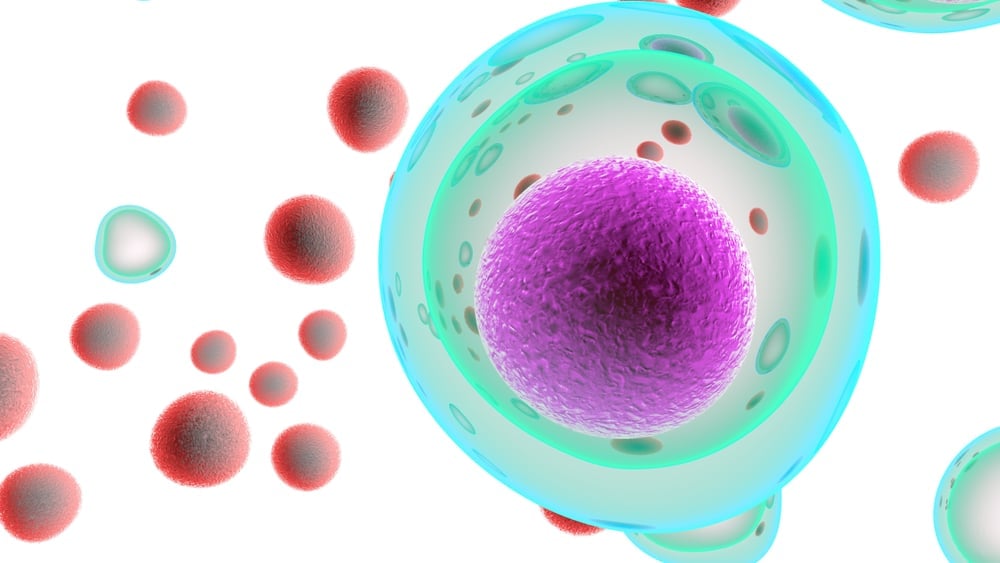
Cells are in a constant state of flux in a developing body. (Photo Credit : Giovanni Cancemi/ Shutterstock)
This has invoked philosophical thought experiments that question the nature of private identity. You lot may have heard the mutual saying that our body completely replaces every cell and changes into a completely new 1 every 7 years. If that's the case, are you the same person as you were 7 years agone? Or is that someone else? What nearly the one in the future… will that as well be you? Or is that a carve up private?
I, for one, feel like the same person I have e'er been when I look back on a central level. Notwithstanding, this is a tricky scenario, so let's see if the claim of our body completely regenerating in vii years holds truthful and maybe go to know our identities a lilliputian ameliorate.
Recommended Video for you:
The Birth of a Jail cell
For the torso to be fully functioning, old cells die and new cells are fabricated. Ane of the ways new cells come about is through the procedure of mitosis. In the jail cell cycle, mitosis is where 2 new nuclei come nearly from the separation of replicated chromosomes. The process of mitosis is itself divided into various stages; namely prophase, pro-metaphase, metaphase, anaphase and telophase. Each stage is a progression of the division of a parent chromosome that results in two girl cells, which are copies of the original prison cell.
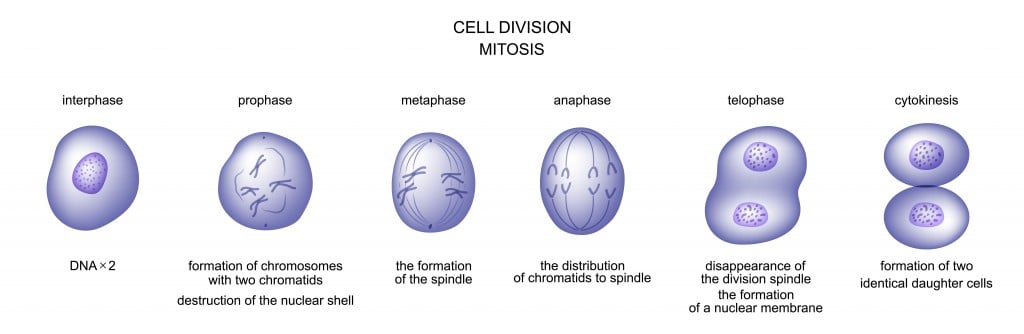
Mitosis (Photo Credit : Artemida-psy/ Shutterstock)
The other process of acquiring new cells is through stem cells. Stem cells carve up over and over to produce different types of specialized cells required in the body. They likewise produce new stem cells, which further the procedure of making new cells. There are three types of stem cells. Embryonic stem cells are responsible for supplying new cells for an embryo as it is developing. They are said to be pluripotent, significant that they can modify into whatsoever blazon of jail cell the body requires. Adult stalk cells are responsible for providing a constant supply of new cells for a developing adult. These cells are multipotent and can only modify into some types of cells that the body requires. Induced pluripotent stem cells are those made in the laboratory. They are fabricated by reprogramming cells from the skin and other areas that can exist inverse into whatsoever jail cell the trunk requires.
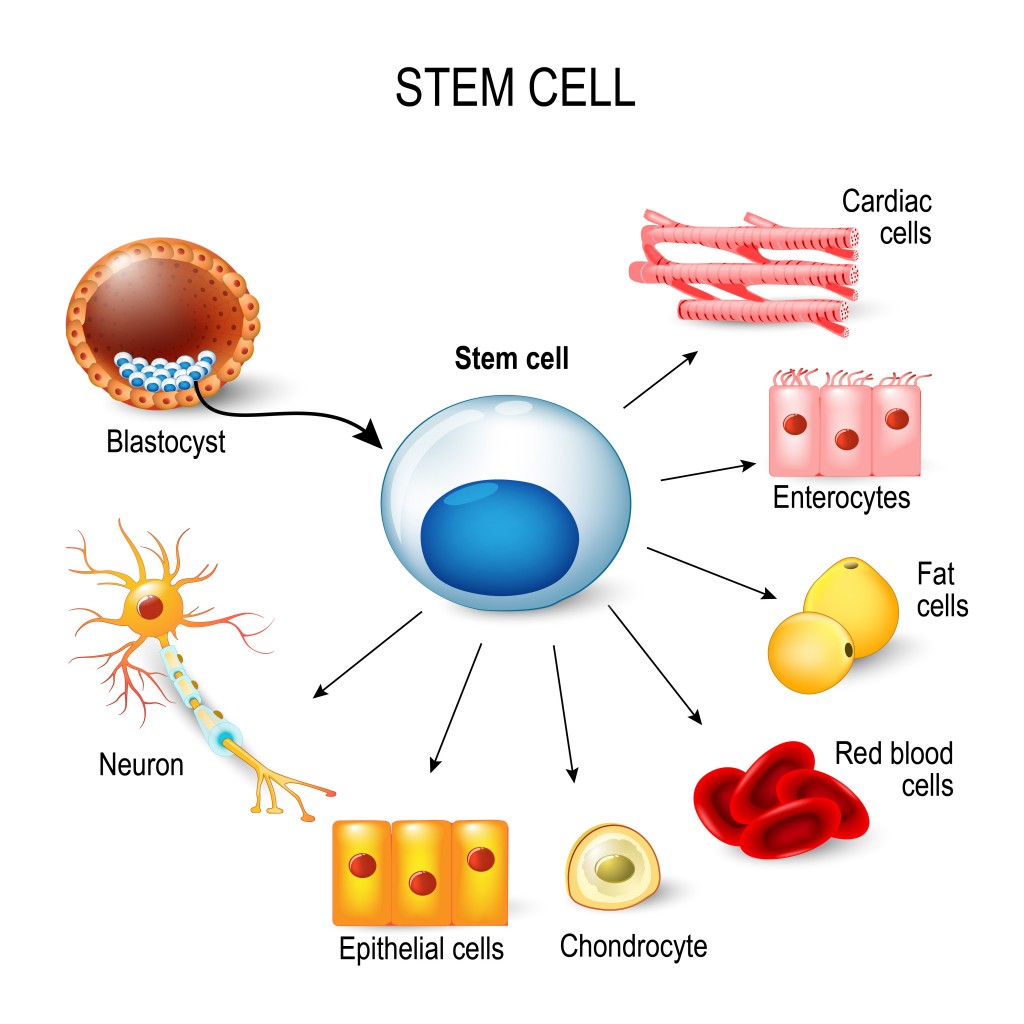
Stem cells and diverse types of cells (Photo Credit : Designua/ Shutterstock)
How practise we know the age of the Cells in our Body?
While trying to determine whether the cortex of our brains ever produces new cells, Dr. Jonas Frisen, a stem cell biologist at the Karolinska Constitute in Stockholm, had to find a new way to appointment the age of cells. The techniques at manus would require tagging Dna with chemicals, but that wasn't virtually a perfect process.
Dr. Frisen had to recollect of a natural tag with which he could deduce the age of the cells. He recalled that nuclear weapons were tested aboveground until 1963, and these tests had injected radioactive carbon-14 into the temper. This carbon-14 enters the DNA of cells as plants exhale it and animals and people swallow it in their food. This DNA is duplicated each time a cell divides. The Deoxyribonucleic acid in any cell is never replaced, although most of the molecules themselves are replaced. Thus, a new cell acquires its Dna equally information technology is formed, including the carbon-14 that got naturally tagged. Dr. Frisen realized that the enrichment of this carbon-14 tag on the Dna could be used to judge the age of the cell.
Dr. Frisen used tissues instead of cells to decide the age, equally a prison cell contains very piddling carbon-xiv for dating. This technique was then used to determine the historic period of various cells in the organs of a human body.
The Real Age of our Body
On July 15th,2005, Dr. Frisen and his colleagues issued their findings on the historic period of various cells in an edition of Cell. They conducted this inquiry with adults in their late 30's. They found that the cells in the muscles of these adults had an average historic period of 15.1 years. On the other extreme, the epithelial cells on the surface of the gut accept a very short life of merely 5 days, on average. That being said, the average age of the cells in the main area of the gut was 15.ix years, on average.

Historic period of the chief body of the gut is 15.9 years (Photograph Credit : Life science/ Shutterstock)
Through other methods, it is known that a cherry-red claret jail cell travels a whopping 300 miles throughout the trunk and has a life of about 4 months. White blood cells live longer than that, lasting an average of about one twelvemonth. Colon cells accept a relatively shorter life of only 4 days; this shorter life is likewise seen in sperm cells, which last but three days. Cells on the skin are constantly changing, as they have to handle the upkeep of an individual and live roughly 2 to 3 weeks. The skeleton of a man could take effectually 10 years to exist completely replaced. A liver takes around 300-500 days to completely renew itself.
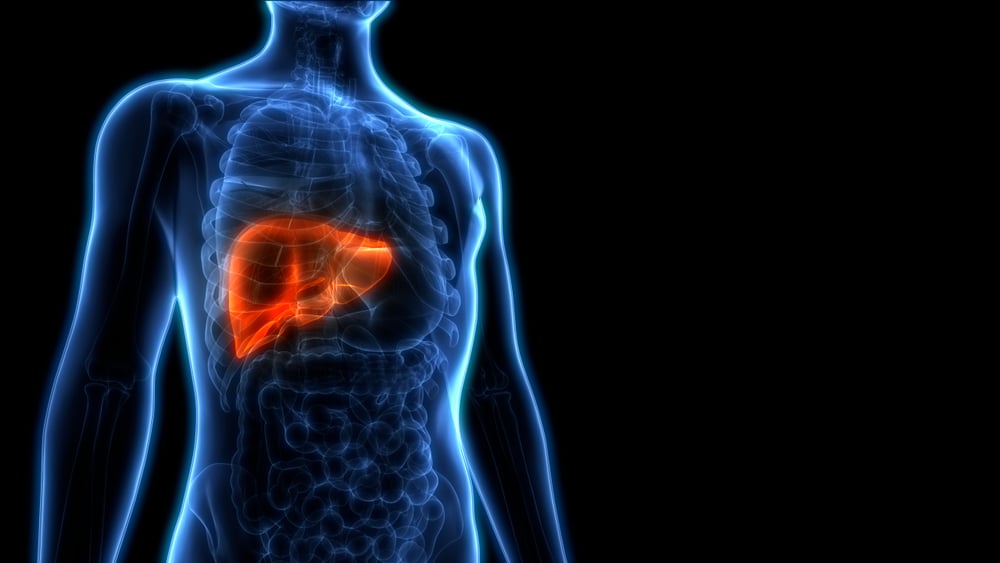
The liver renews in 300-500 days (Photo Credit : Magic mine/ Shutterstock)
Now comes the big question pertaining to our identities: do cells in the brain get completely replaced too? Dr. Frisen and company found that the cells in the visual cortex were exactly the aforementioned age as the individual, showing that after nativity, no new neurons are generated in the cerebral cortex, at least in numbers that would make a divergence. They also found that the cells in the cerebellum of the individual were slightly younger, which gives credence to the thought that development in the cerebellum continues later on nascence.

Neurons remain the same throughout one's life (Photograph Credit : whitehoune/ Shutterstock)
The Bottom Line
The cells in every human body are in a constant state of flux throughout the individual'south lifetime. Although almost all the cells dice and are consistently replaced, their life cycles vary from dissimilar organs, types, and functions. This lifecycle could be as brusque equally iii days or as long as 16 years!
The thing that makes you the person you are (your brain) doesn't make new neurons subsequently its inception. The brain where your memories, ideas, beliefs, personality and every other detail of you remains the aforementioned throughout your life.
In conclusion, the merits that our body completely changes every 7 years is fake. A more nuanced claim would be that virtually of the body changes every x-fifteen years, while some parts of the body remain the same, dying only with the individual.
Suggested Reading
-
Mountains Beyond Mountains: One doctor'south quest to heal the world -
Human being Physiology: An Integrated Approach (7th Edition) -
The Emperor of All Maladies


Was this commodity helpful?
Aye No
Help us make this article better
Follow ScienceABC on Social Media:
Nigh the Author
Vishal is an Architect and a pattern addict. He likes making trippy patterns in his reckoner. Fascinated by engineering science's role in humanity's evolution, he is constantly thinking about how the time to come of our species would plow out – sometimes at the peril of what'south currently going on around him.
.
Science ABC YouTube Videos
-
 Gut Microbiome Explained in Simple Words
 -
 Particle accelerators: What are they, how exercise they work and why are they important to us?
 -
 How Do Neurons Work?
 -
 How Scientifically Authentic Is The HBO Miniseries Chernobyl?
 -
 Cellular Respiration: How Practise Cell Get Energy?
 -
 Multiverse Theory Explained: Does the Multiverse Really Exist? Truth of Multiple Realities
 -
 What Exactly is Spacetime? Explained in Ridiculously Simple Words
 -
 What Are The Dissimilar Atomic Models? Dalton, Rutherford, Bohr and Heisenberg Models Explained
Source: https://www.scienceabc.com/humans/true-body-completely-changes-every-7-years.html
0 Response to "Every How Many Years Do Your Cells Recreate Again"
Post a Comment